Smart Home & Sensor Glossary: 45+ Terms Explained (India, 2026)
Key takeaways
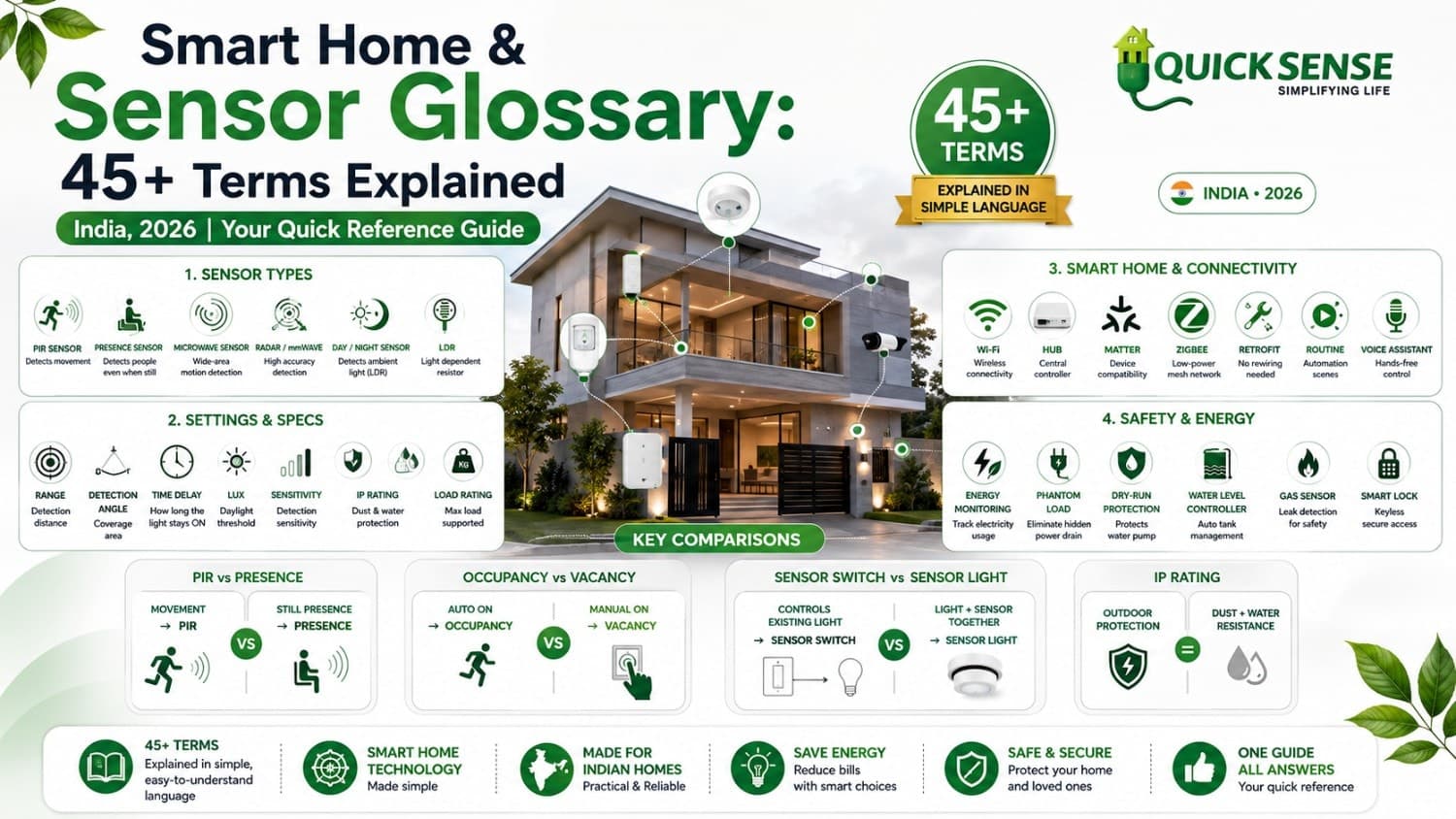
- This glossary explains, in plain language, the smart-home and sensor terms you'll meet when buying or setting up automation in India.
- Knowing a few key differences — PIR vs presence, occupancy vs vacancy, sensor switch vs sensor light — prevents most buying mistakes.
- Specs like time delay, lux, IP rating, and load rating decide whether a device actually works in your space.
- Bookmark or link to this page as a quick reference whenever a product description throws jargon at you.
Buying anything for a smart home means wading through jargon — PIR, lux, IP67, occupancy vs vacancy, Matter, no-neutral. Most of it sounds more complicated than it is. This glossary explains the terms you'll actually meet, in plain English, with an India angle. Skim it, or bookmark it and come back when a product description confuses you.
Sensor types
- Motion sensor — a device that detects movement and switches a light or appliance on, then off after you leave.
- PIR (Passive Infrared) sensor — the most common motion sensor; it detects the body heat of a moving person. Affordable and reliable for most rooms. See PIR vs microwave vs radar.
- Microwave sensor — emits radio waves and detects motion over a wider area, even through thin walls and glass. Good for large halls, basements, and parking.
- Radar / mmWave sensor — the newest tech; detects tiny micro-movements, so it senses presence even when you're still.
- Presence sensor — keeps the light on while a person is present (even sitting still), unlike a basic PIR. Ideal for offices and study rooms — here's presence vs motion.
- Occupancy sensor — turns lights on automatically when a space is occupied and off when vacant.
- Vacancy sensor — you switch it on manually, and it turns off automatically when the room is empty — saves even more, popular for cabins.
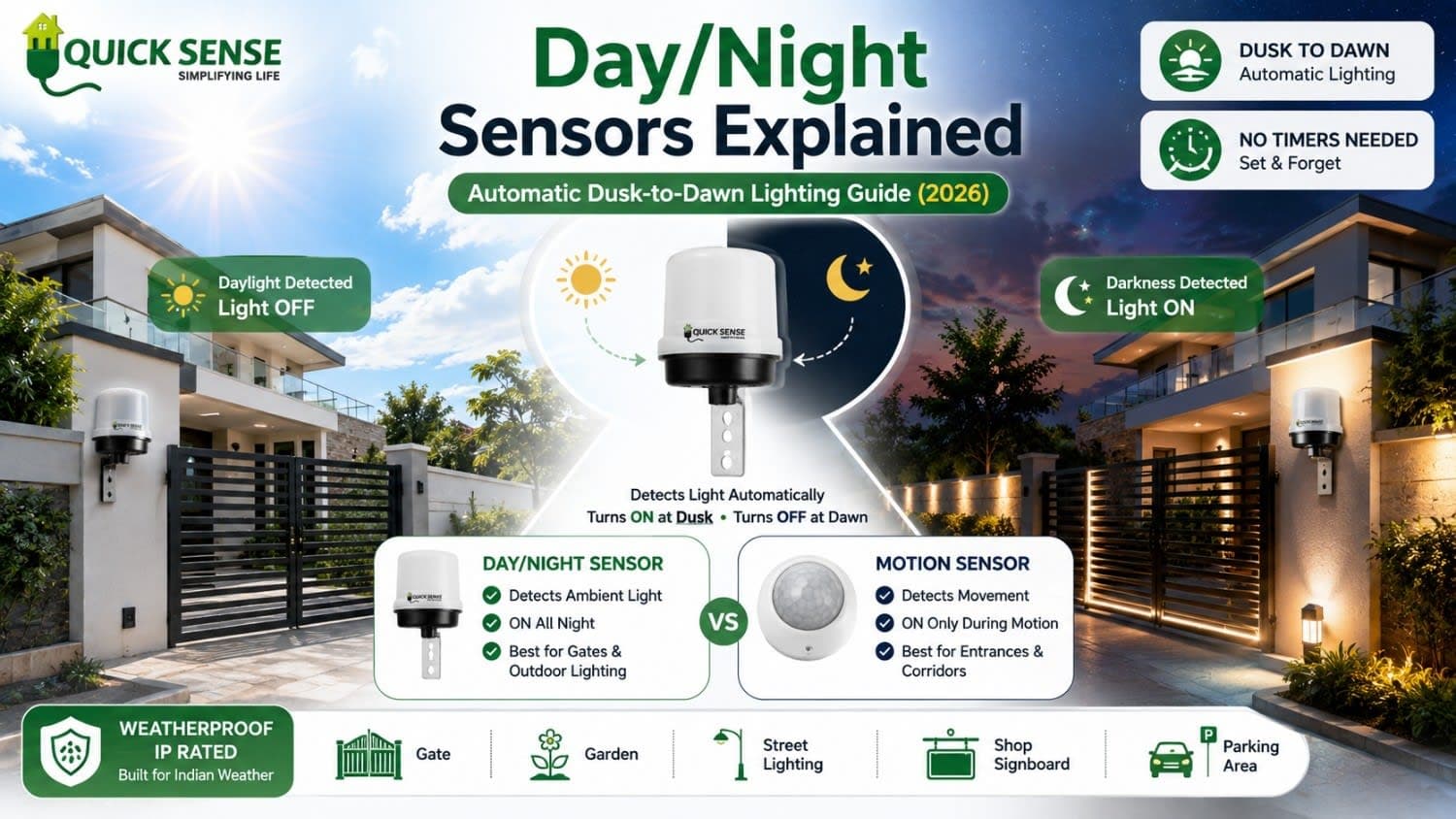
- Photocell / day-night / dusk-to-dawn sensor — switches lights on at dusk and off at dawn based on ambient light, not motion. Great for gate and street lighting.
- LDR (Light Dependent Resistor) — the light-sensing component inside a day/night sensor; its resistance changes with light level.
- Ultrasonic sensor — detects motion using sound waves; less common in homes than PIR.
Settings & specifications
- Detection range — how far the sensor can detect movement.
- Detection angle / field of view — the width of area the sensor covers, e.g. 120° or 360°.
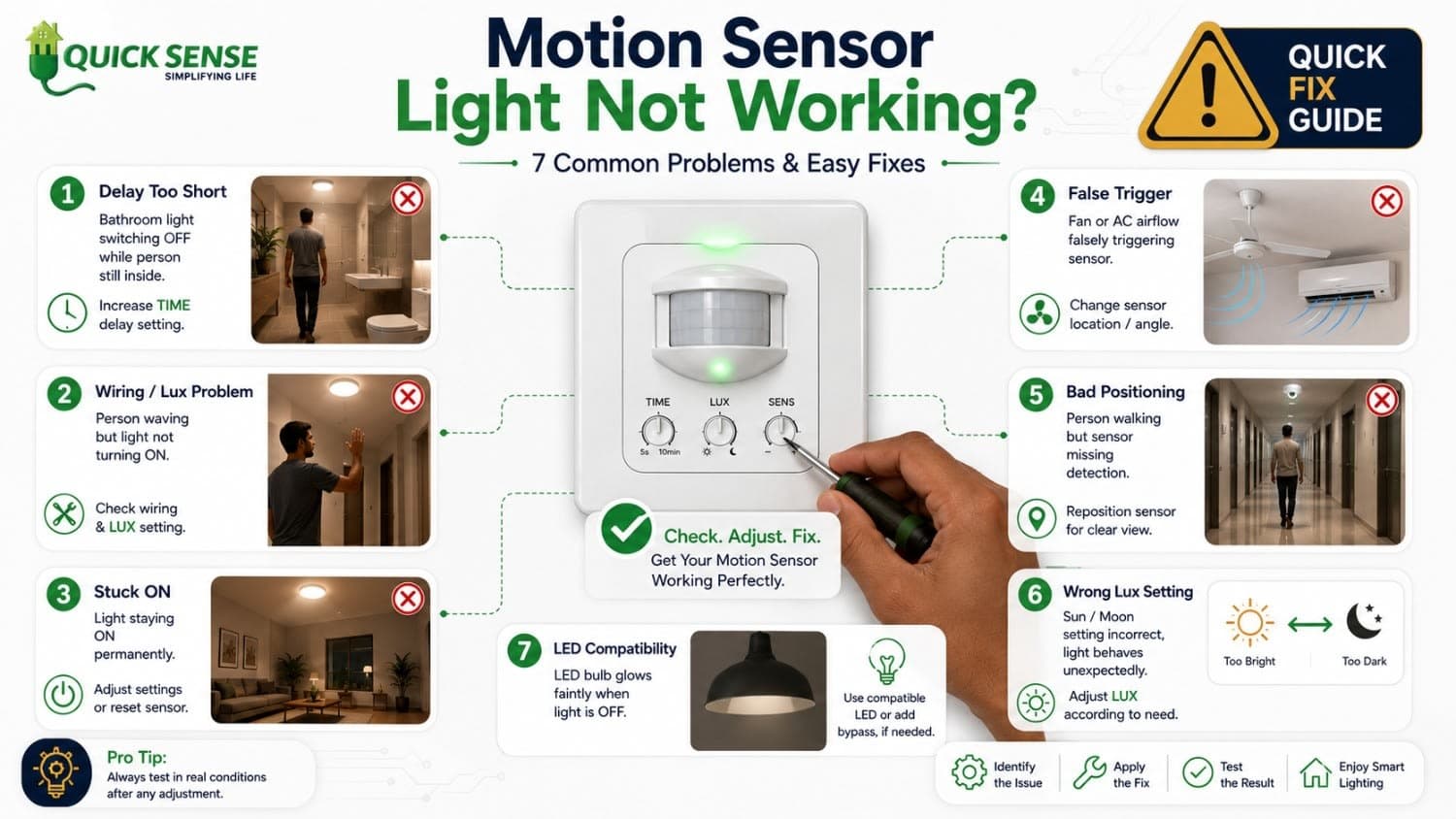
- Time delay — how long the light stays on after the last movement. Adjustable on good units.
- Lux level — a daylight threshold; it stops the light switching on when there's already enough natural light.
- Sensitivity — how easily the sensor triggers; tune it down to avoid false triggers.
- False trigger — the light coming on with no one there, usually caused by heat or airflow (AC, fans, sunlight).
- IP rating — Ingress Protection; how well a device resists dust and water. Essential for anything outdoors in India.
- Load / load rating — the maximum wattage a switch or sensor can safely control.
- Neutral / no-neutral — whether the switch needs a neutral wire; "no-neutral" units can cause faint LED glow if not matched correctly.
Lighting & switches
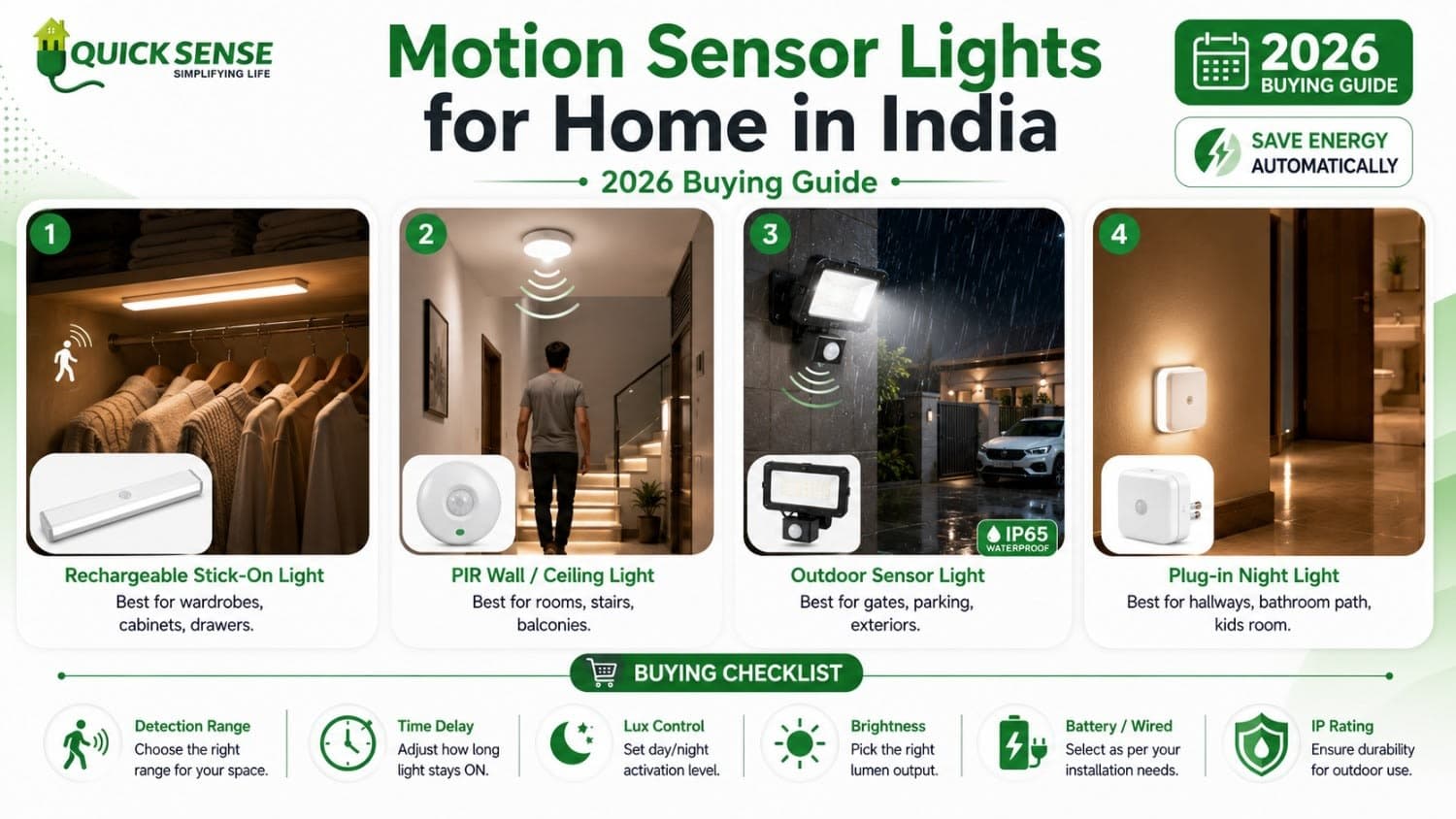
- Sensor switch (motion sensor switch) — replaces your wall switch to automate lights you already have wired. See the buying guide.
- Sensor light — a self-contained fixture with the light and sensor built in; ideal for wardrobes, cabinets, and outdoors.
- Smart switch — a Wi-Fi or app-controlled switch that also allows scheduling and remote control.
- Smart bulb — a bulb you can control (on/off, brightness, colour) via app or voice.
- Timer switch — runs a device for a set time or at set times — common for geysers and water motors.
- Dimmer — adjusts light brightness; some sensor switches include dimming.
Smart home & connectivity
- Home automation — using devices to control lights, appliances, and systems automatically or remotely. New to it? Start with getting started.
- Smart home — a home where connected devices work together for convenience, safety, and savings.
- Hub / gateway — a central device that connects and coordinates other smart devices.
- Wi-Fi — the most common way home smart devices connect; no extra hub needed.
- Zigbee / Z-Wave — low-power wireless standards for smart devices, usually needing a hub.
- Matter — a common standard so devices from different brands work together; still maturing in India.
- Retrofit — a device that fits your existing wiring or setup, with no renovation — great for renters.
- Scene / routine / automation — a saved set of actions (e.g. "night mode" dims lights and locks the door).
- Voice assistant — controls devices by voice (Alexa, Google); Hindi/regional support keeps improving.
Safety, energy & power
- Energy monitoring — tracking real electricity use so you can see where power goes and cut waste. See how sensors cut bills.
- Standby / phantom load — power drawn by devices that are "off" but still plugged in.
- Dry-run protection — a pump feature that cuts the motor when there's no water, protecting it from damage.
- Water level controller / float switch — automatically starts and stops a water motor based on tank level, preventing overflow and dry runs.
- Smart lock — a lock opened by PIN, fingerprint, card, or app instead of a key.
- Gas detector / leak sensor — gives early warning of a gas leak or other hazard.
- Surge protection — guards electronics against voltage spikes, useful with India's fluctuating supply.
The few terms worth learning first
If you only remember a handful, make it these: PIR vs presence (movement vs staying-still), occupancy vs vacancy (auto-on vs manual-on), sensor switch vs sensor light (controls wired lights vs a fixture on its own), and IP rating (weatherproofing). Get those right and you'll avoid the mistakes most first-time buyers make. For where these fit at home, see our guides on bathroom lighting and staircase lighting, or what it all costs.
Still stuck on a term or a product? Ask our team and we'll explain it in plain language — or browse our product range to see these in action.