Day/Night Sensors Explained: Automatic Dusk-to-Dawn Lighting in India (2026)
Key takeaways
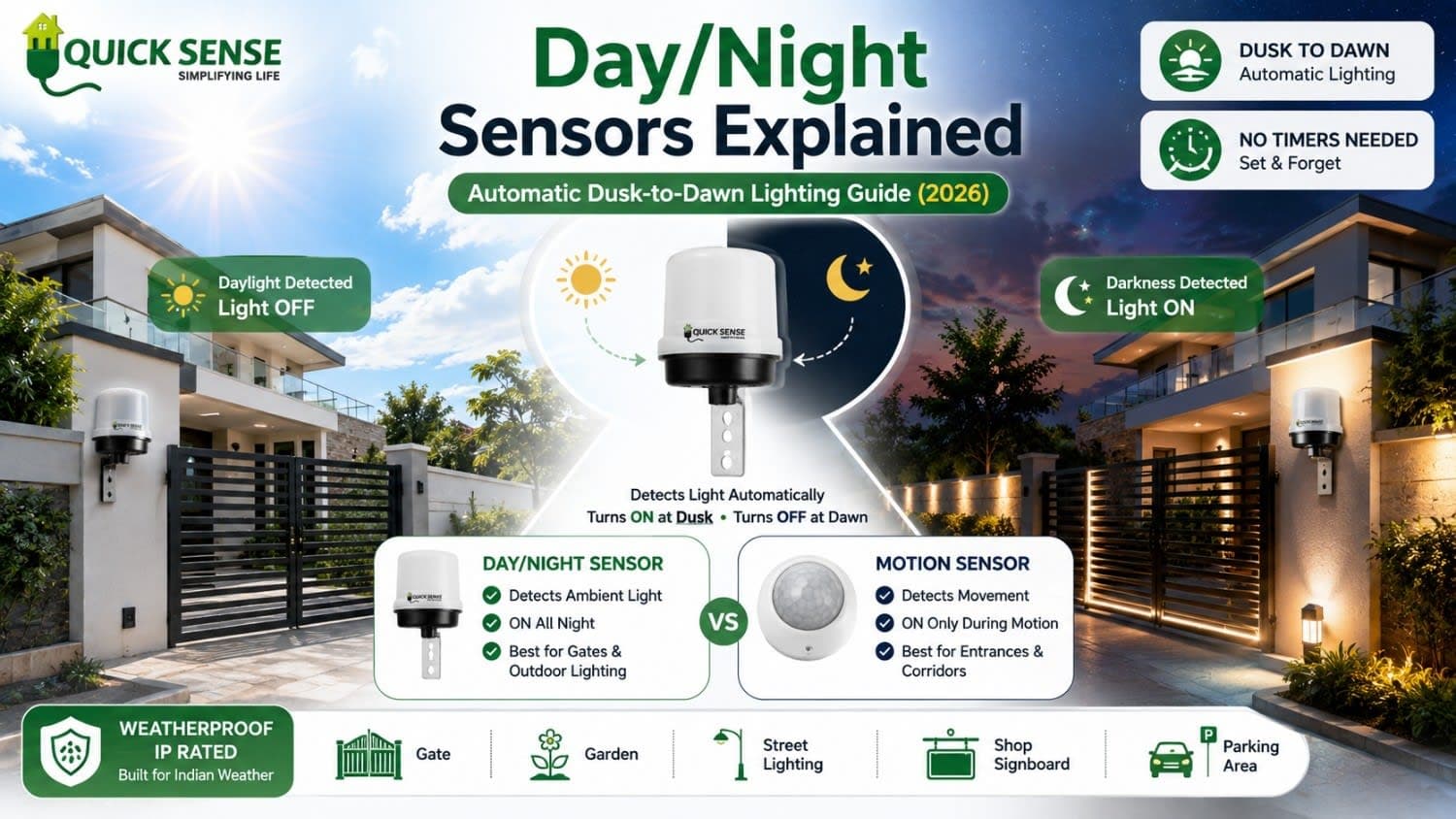
- A day/night (photocell) sensor switches lights ON at dusk and OFF at dawn on its own, based on ambient light — no timers, no manual switching.
- It's different from a motion sensor: a day/night sensor keeps the light on all night, while a motion sensor triggers only on movement.
- It's ideal for gate lights, society and street lighting, shop signboards, and garden or security lighting.
- For outdoor use in India, the sensor must be weatherproof (IP-rated) to handle heat, dust, and monsoon rain.
Here's a small daily chore almost nobody enjoys: switching the gate light or porch light on every evening and off every morning. Miss it at night and the entrance is dark; forget it in the morning and it burns pointlessly till noon. Multiply that across a society's street lights or a shop's signboard, and it's a real waste of both effort and electricity.
A day/night sensor quietly solves all of that. You may know it as a photocell or a dusk-to-dawn sensor — whatever the name, it does one clever thing: it watches the light around it and switches your lamp on when it gets dark, off when it gets bright. Set it once and forget it exists. Here's how it works and where it earns its keep.
How does a day/night sensor work?
Inside is a light-sensitive component that constantly measures the ambient light level. As dusk falls and the surrounding light drops below a set point, the sensor closes the circuit and the light comes on. At dawn, when daylight rises again, it opens the circuit and switches off. There's no timer to program and nothing to adjust with the seasons — because it reacts to actual light, it automatically follows shorter winter evenings and longer summer days on its own.
Day/night sensor vs motion sensor — what's the difference?
This is the question people get stuck on, and the answer decides what you should buy:
- A day/night (photocell) sensor reacts to light level. It keeps the lamp on for the whole dark period — dusk to dawn.
- A motion sensor reacts to movement. It switches on only when someone passes, then off after a short delay (more on those in our presence vs motion guide).
So if you want your gate lit all night, you want a photocell. If you only want light when someone approaches, you want motion. And the best outdoor security setups combine both — the light stays on at a low level all night (photocell) and jumps to full brightness on movement (motion). If you're comparing the underlying sensing tech, our PIR vs microwave vs radar breakdown helps.
Where day/night sensors shine
- Gate, porch & entrance lights — the classic use; never a dark doorway again.
- Society & street lighting — common-area lights that manage themselves, no watchman toggling switches.
- Shop signboards & hoardings — your board lights up exactly when footfall picks up in the evening, a natural fit alongside smart retail lighting.
- Garden & pathway lights — dusk-to-dawn ambience without a daily routine.
- Building exteriors & security lighting — a lit perimeter all night is a quiet deterrent.
What to check before you buy
- Adjustable light threshold: a good sensor lets you tune how dark it must get before switching on, so it isn't triggered by a passing cloud.
- Load rating: match it to the total wattage of the lights it will control, with headroom.
- Weatherproofing (IP rating): for anything outdoors in India this is essential — heat, dust, and monsoon will finish off an indoor-rated unit fast.
- Mounting position: place the sensor where it reads true sky light, not under the very lamp it controls or beside another light source, or it will get confused.
- Build quality & warranty: outdoor electronics live a hard life; buy something built for it, with support behind it.
A quick word on installation
A day/night sensor sits on your lighting circuit, so unless it's a simple plug-in unit, let a qualified electrician wire it in — especially for gate, street, or signboard lighting that may run higher loads. It's a quick job done right, and then it runs untouched for years.
What you get out of it
Three things, really. You stop wasting electricity on lights left burning into the day. You remove a small daily chore for every outdoor light you own. And you get a home or shopfront that's reliably lit at night — safer, more welcoming, and a mild deterrent to anyone up to no good. Pair a photocell with motion sensing and you also capture the energy savings we detail in how motion sensors cut energy bills. It's the kind of small automation you install once and quietly benefit from every single evening.
Just getting into home automation? Our getting started guide shows where this fits, and the cost guide helps you budget. Want help choosing the right day/night sensor for your gate, shop, or society? Tell us your setup and we'll point you to the right fit, or browse our product range.