PIR vs Microwave vs Radar (mmWave) Sensors: Which One Should You Choose?
Key takeaways
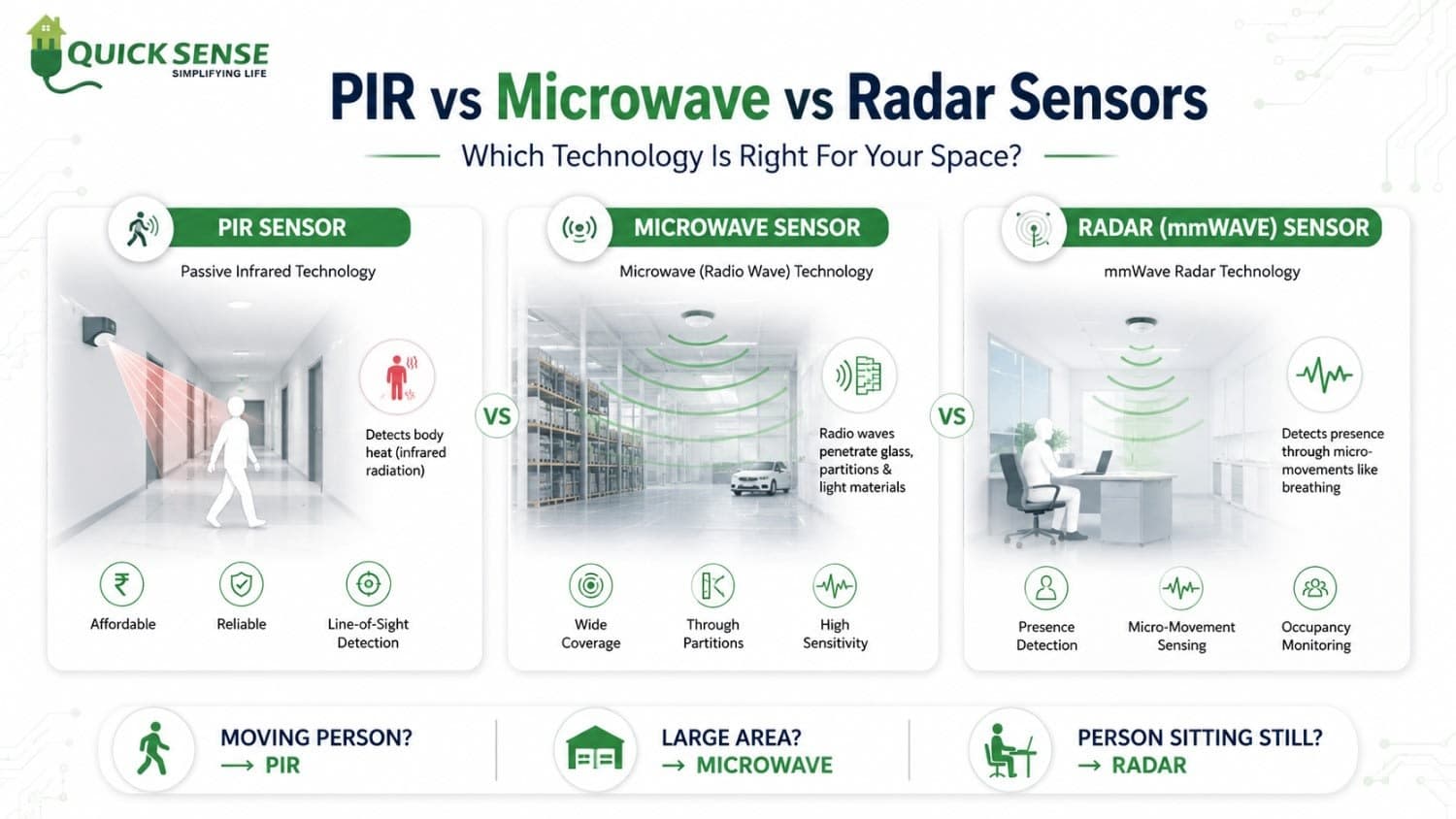
- PIR detects movement, microwave covers wide or partitioned areas, radar (mmWave) detects still presence.
- PIR suits most homes, presence sensors suit still spaces, microwave suits large areas.
- Choose the sensor by the space — not one type for everything.
Not all motion sensors are the same. The technology inside decides where a sensor works brilliantly — and where it fails. If you've ever had a light switch off while you were sitting still, or trigger from the next room, the wrong sensor type was probably to blame. Here's how PIR, microwave, and radar (mmWave) sensors really compare.
1. PIR (Passive Infrared) sensors
PIR sensors detect the body heat of a moving person. They're the most common, most affordable, and most reliable choice for everyday spaces.
- Best for: corridors, staircases, bathrooms, balconies, entrances.
- Strengths: low cost, low power, no false triggers through walls.
- Limitations: needs line of sight; may switch off if you sit very still.
See our PIR motion sensors for these everyday use cases.
2. Microwave sensors
Microwave sensors emit radio waves and measure the reflection, so they detect motion through thin walls, glass, and partitions over a wider area.
- Best for: large halls, basements, parking, warehouses.
- Strengths: wide coverage, works through thin barriers, sensitive to small movement.
- Limitations: can over-trigger if range isn't tuned; slightly higher cost.
Explore microwave sensors for wide-area coverage.
3. Radar / mmWave presence sensors
The newest technology, mmWave radar, detects even tiny micro-movements like breathing — so it knows a room is occupied even when people are perfectly still.
- Best for: offices, study rooms, conference rooms, bedrooms.
- Strengths: true presence detection, no "lights off while sitting" problem, privacy-friendly (no camera).
- Limitations: premium cost; needs correct zone configuration.
For spaces where people stay still, our presence sensors are the right fit.
Quick decision guide
- People moving through a space? → PIR.
- Large area or through partitions? → Microwave.
- People sitting still for long periods? → Radar / presence.
The bottom line
There's no single "best" sensor — there's the best sensor for the space. Mixing technologies across a building gives you reliable automation everywhere. Not sure which to use where? Ask our team and we'll map the right sensor to each room.