Motion Sensor Lights for Home in India: 2026 Buying Guide
Key takeaways
- Motion sensor lights are self-contained fixtures with the light and sensor built in — different from sensor switches that control your existing wired lights.
- Match the type to the spot: rechargeable stick-on lights for wardrobes and cabinets, PIR wall or ceiling lights for rooms and stairs, and IP-rated units for outdoors.
- What actually matters before buying: detection range and angle, adjustable time delay, lux (daylight) control, brightness, and power source.
- For outdoor use in India, weatherproofing (a proper IP rating) is non-negotiable given dust, heat, and monsoon rain.
Motion sensor lights are one of those upgrades that feels almost too simple. You mount one, walk past it, and it does exactly what you hoped — lights up, then quietly switches off when you're gone. No app, no wiring headache, no thinking about it.
But walk into any store or scroll a marketplace and you'll find a dozen types at wildly different prices, and it's not obvious which one is right for your wardrobe versus your gate. So before you buy, here's a clear, no-fluff guide to the kinds of motion sensor lights sold in India in 2026, where each one shines, and what actually matters when you're choosing.
First: sensor lights vs sensor switches (they're not the same)
This trips people up. A motion sensor light is a self-contained fixture — the light and the sensor are built into one unit, so you just mount it and it works. A motion sensor switch, on the other hand, replaces your wall switch and controls the lights you already have wired in the ceiling. If your room is already wired for lighting, a switch is often the neater choice — we cover that in the motion sensor switch buying guide. This article is about the lights themselves.
The main types of motion sensor lights
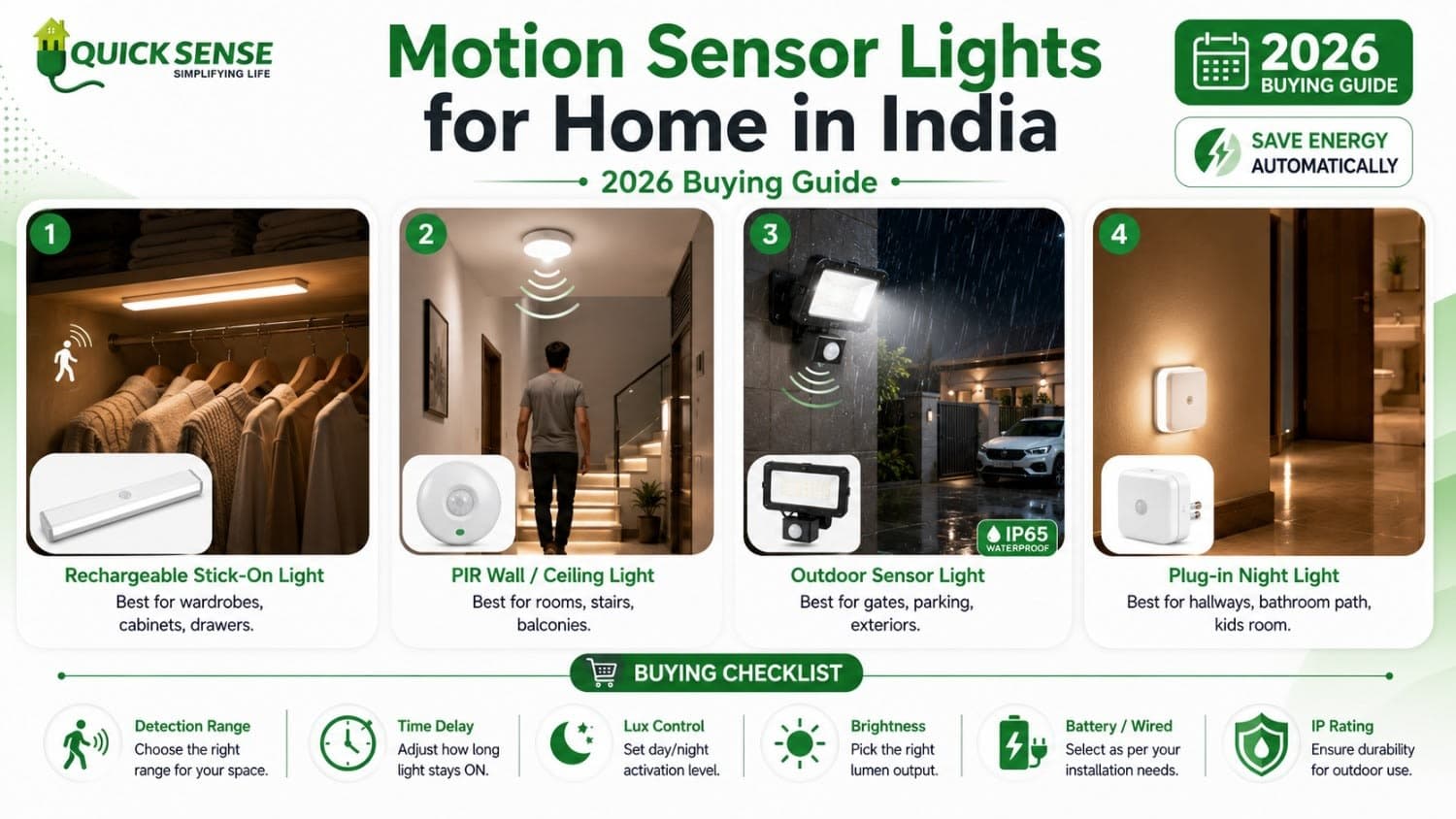
1. Rechargeable / battery stick-on lights
Slim LED bars or pucks with a built-in sensor and a rechargeable battery. Because there's no wiring, you can stick them almost anywhere — and that's their whole appeal. Perfect for wardrobes, kitchen cabinets, drawers, staircases, and dark passages. You charge them via USB every few weeks. Great for renters and retrofits.
2. PIR wall & ceiling lights (indoor)
Mains-powered fixtures with a PIR sensor, meant for regular rooms, corridors, entrances, and balconies. Brighter and always ready (no charging), so they suit higher-traffic spots. If you have stairs, this is the category to look at — see our staircase lighting guide.
3. Outdoor sensor lights (wall & flood)
Weatherproof units for gates, driveways, parking, and building exteriors — usually brighter, with longer range, and doubling as a security deterrent. The one rule here: it must be properly IP-rated for the outdoors (more on that below).
4. Plug-in sensor night lights
Tiny lights that plug into a socket and glow softly when they detect movement at night. Cheap, effortless, and genuinely useful for hallways, kids' rooms, and the path to the bathroom.
Where should you actually use them?
- Wardrobes & cabinets: rechargeable stick-on lights.
- Staircases & corridors: PIR wall lights or stick-on bars.
- Entrances & balconies: PIR wall lights.
- Bathrooms: a sensor light or, better, a sensor switch — see the automatic bathroom lighting guide.
- Gates, parking, exteriors: IP-rated outdoor sensor lights.
- Hallways at night: plug-in night lights.
What to check before you buy
Ignore the marketing and look at these:
- Detection range & angle: match it to the space — a wide angle for a room, a focused throw for a driveway.
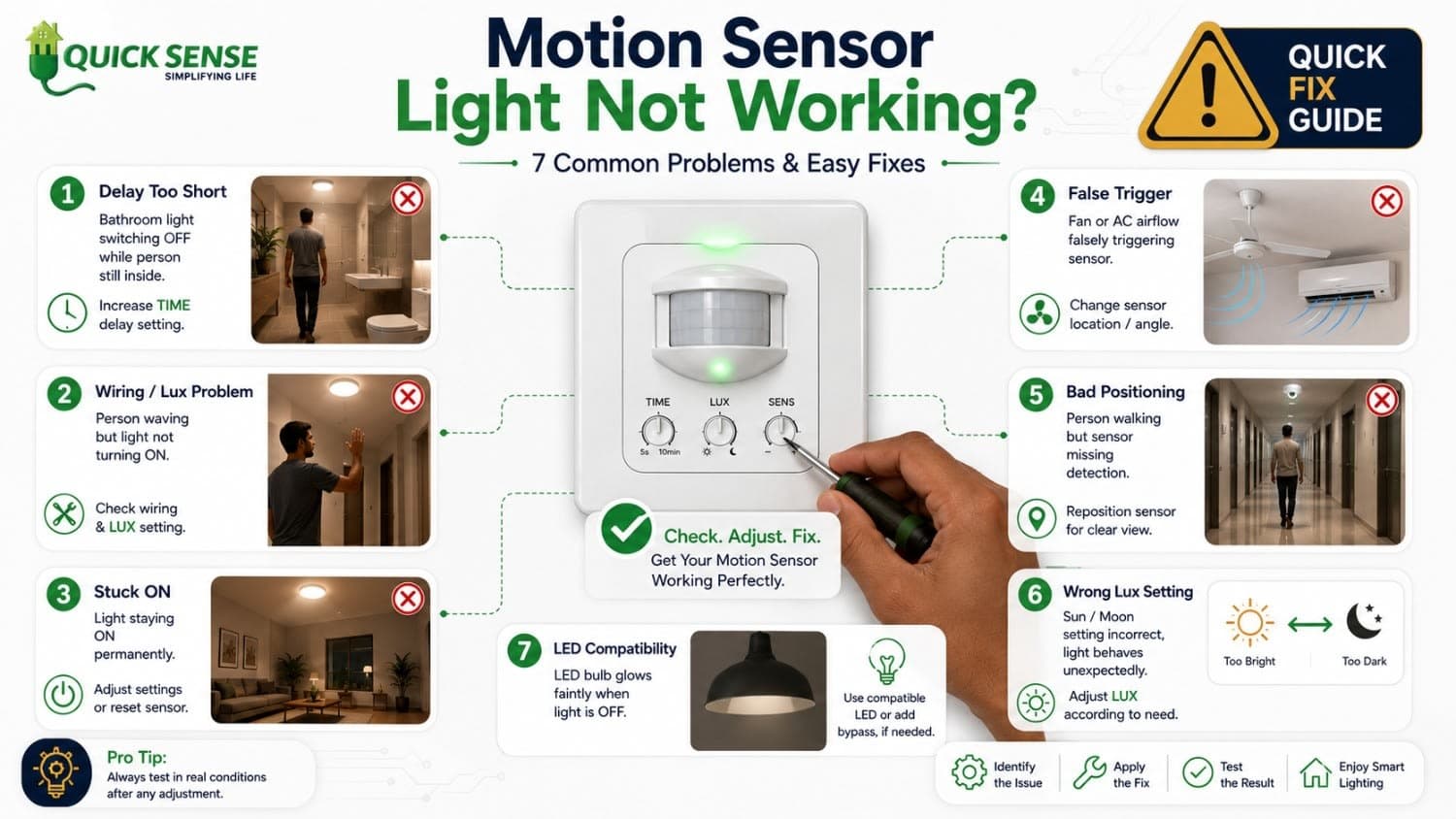
- Adjustable time delay: how long it stays on after the last movement. A must for comfort.
- Lux (daylight) control: stops the light triggering in daytime, which saves power and battery.
- Brightness (lumens): a wardrobe strip needs far less than an outdoor flood light.
- Power source: rechargeable for no-wiring spots, mains for high-use areas.
- IP rating (outdoor only): non-negotiable in India — see below.
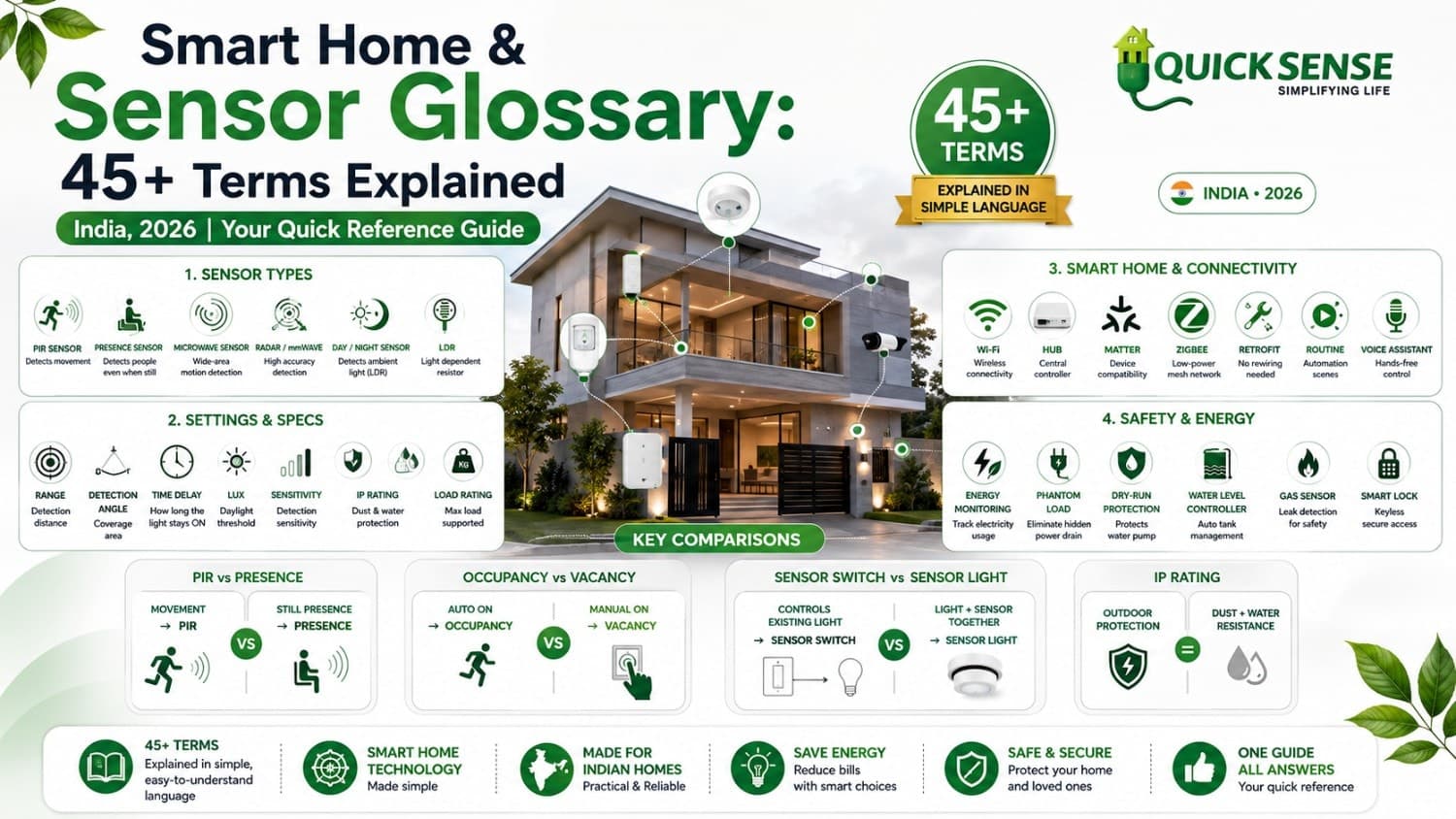
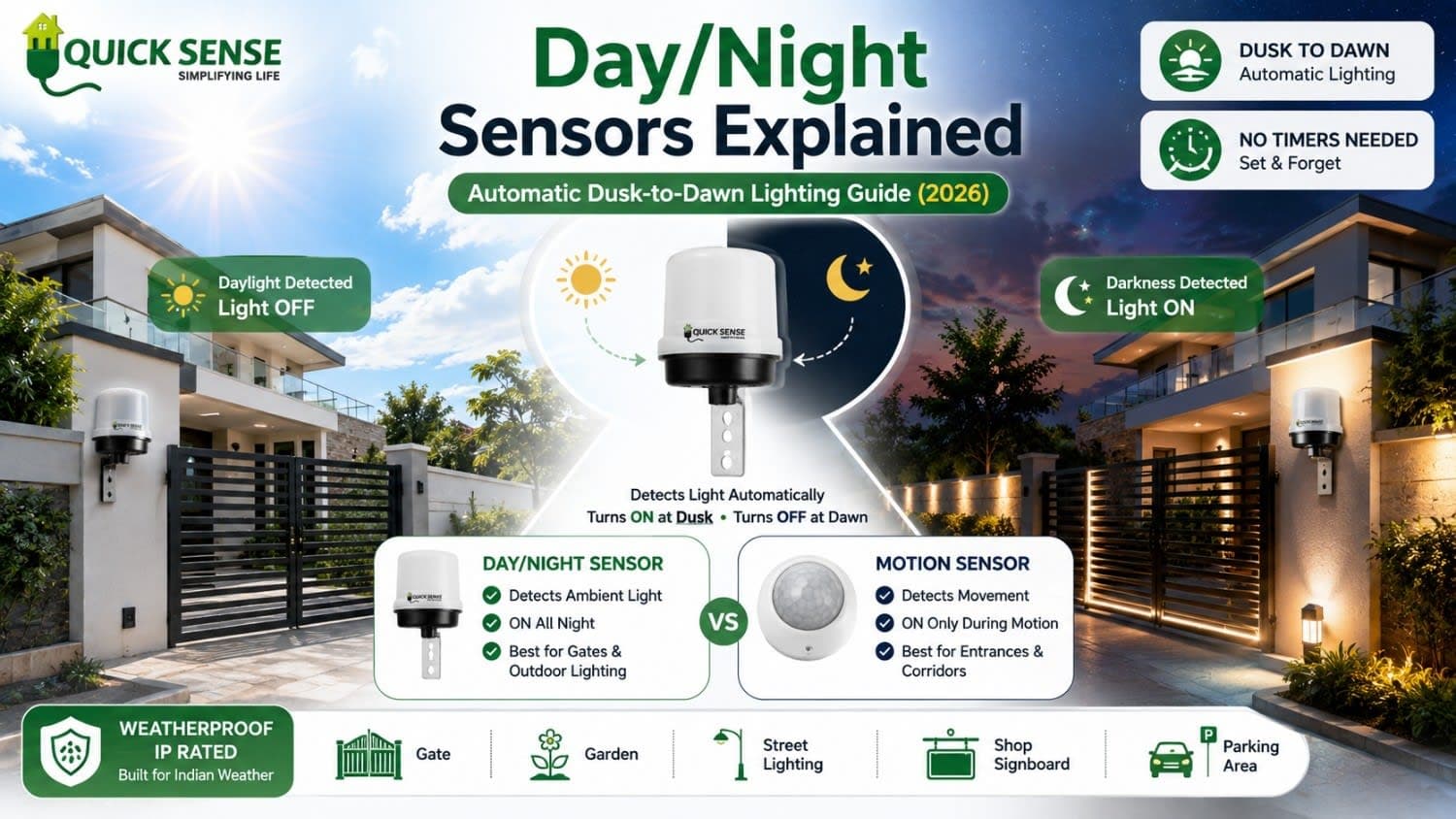
- Sensor type: most home lights use PIR; for large or through-partition areas a microwave sensor works better (here's the difference between PIR, microwave, and radar). And if people sit still where the light is, you'll want presence detection so it doesn't switch off on them.
The one thing people skip: weatherproofing (IP rating)
If a light is going outdoors, its IP rating is the single most important spec. India throws everything at outdoor fixtures — summer heat, dust, and months of monsoon rain. A light rated for dry indoor use will fail fast outside. Look for a clearly stated outdoor/IP rating, and mount it where it isn't taking a direct waterfall off the roof.
Battery vs wired: which should you pick?
Simple rule of thumb. If there's no wiring and the spot is used occasionally — a wardrobe, a drawer, a rarely-used passage — go rechargeable; the freedom to stick it anywhere wins. If it's a high-traffic area used every day, go mains-powered so you're never dealing with a dead battery at the wrong moment.
Do they really save on the bill?
They do, because the light is on only when someone's actually there instead of burning for hours in an empty room. The savings are biggest in spaces used briefly or intermittently — exactly where these lights go. We put numbers to it in how motion sensors cut energy bills.
Bottom line
There's no single "best" motion sensor light — there's the best one for the spot. Rechargeable for wardrobes and cabinets, PIR wall lights for rooms and stairs, IP-rated units outdoors, and a night light for the hallway. Get the match right and every one of them just quietly does its job.
Not sure which to pick for your home? See realistic budgets, browse our motion sensor range, or tell us your space and we'll point you to the right light.