Smart Lighting for Showrooms & Retail Stores: Cut Bills, Sell More
Key takeaways
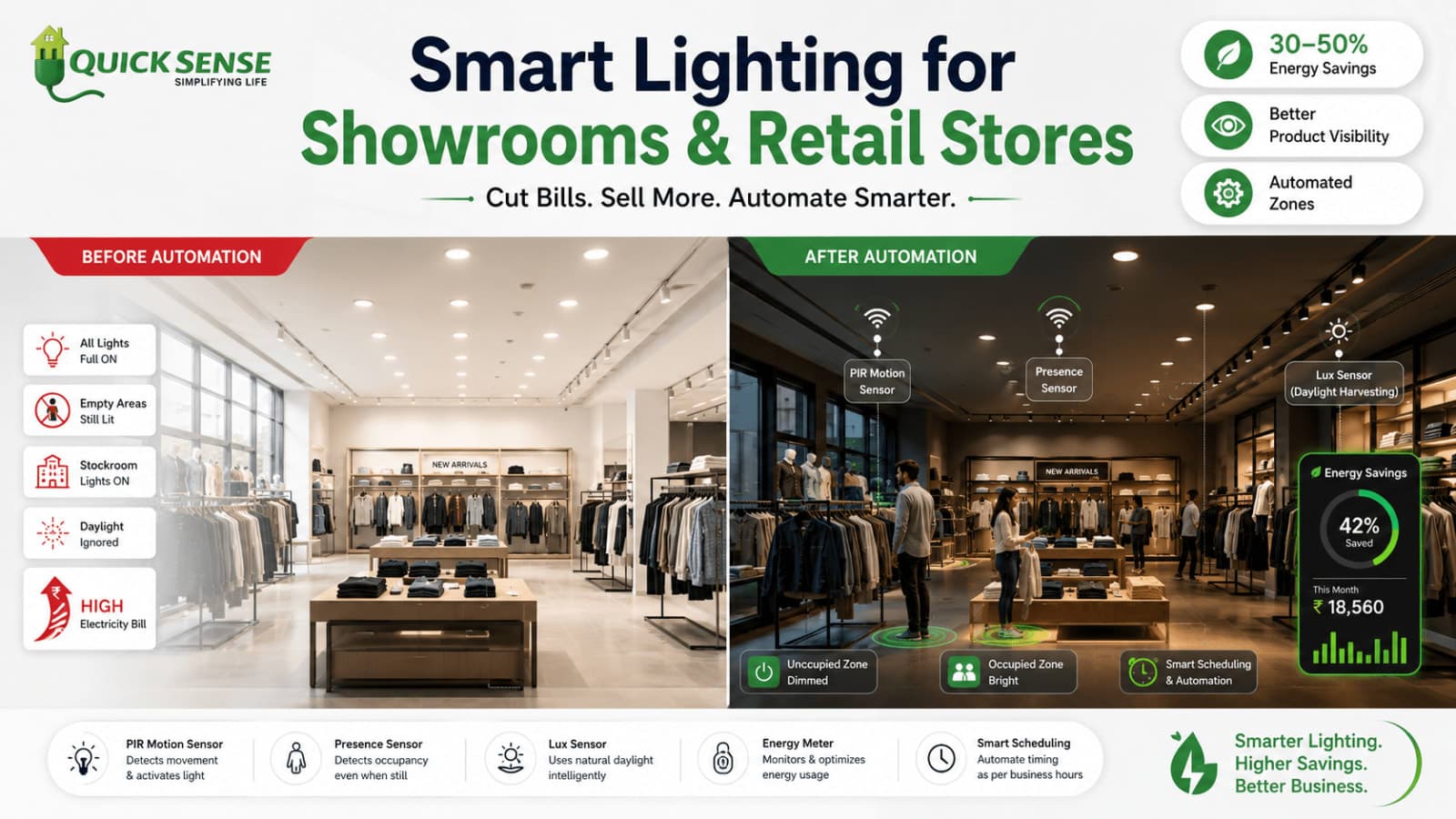
- Lighting is 30–50% of a retail electricity bill — automation cuts the waste in empty and daylit zones.
- It also helps sell more: spotlighting and reactive window lighting lift footfall and pickup.
- Retrofit-friendly — start with a few high-impact zones and measure the savings.
For most Indian retail stores and showrooms, lighting is the single largest controllable expense after rent and staff — and it runs at full power for 10–14 hours a day, often in areas nobody is standing in. But lighting isn't just a cost; it's also one of your strongest silent salespeople. Retail store lighting automation tackles both sides at once: it slashes the electricity you waste and sharpens the way products look on the shelf. Here's how it works, what to expect, and how to roll it out.
Lighting: the hidden cost most retailers overlook
Walk through any store after the morning rush and you'll see the problem — fully lit stockrooms with no one inside, display windows blazing in bright afternoon daylight, and back aisles lit exactly like the busy front. Every one of those is money leaving the till. In a typical retail space, lighting can account for 30–50% of the electricity bill, and a large share of that is simply burning in empty or over-lit zones.
The fix isn't dimmer, gloomier stores. It's intelligent lighting that's bright exactly where and when customers are — and quietly efficient everywhere else.
What is retail lighting automation?
Retail lighting automation uses sensors and smart controls to adjust lighting based on real conditions instead of a manual switch. The core building blocks:
- Occupancy & motion sensors — turn lights on when someone enters an aisle, storeroom, or trial room, and off shortly after they leave. Explore the right type in our motion sensors and presence sensors range.
- Daylight (lux) sensors — dim or switch off electric lights near windows and skylights when natural daylight is already doing the job (called "daylight harvesting").
- Zoning & scheduling — group lights by area (window, main floor, billing, storeroom) so each zone follows its own rule and operating hours.
- Wide-area sensing — for large showrooms and basements, microwave sensors cover bigger spaces and see through thin partitions.
Side 1: How it cuts your electricity bill
1. Stop lighting empty spaces
Stockrooms, fitting rooms, staff areas, and back aisles are occupied only part of the day. Occupancy sensors make sure they're lit only when someone's actually there — often a 40–60% reduction in those zones alone.
2. Harvest free daylight
Stores with glass fronts and skylights flood with daylight for much of the day. Lux-based controls automatically trim electric lighting to maintain a steady brightness, cutting front-of-store energy without anyone noticing a difference.
3. Match lighting to footfall and hours
Scheduling and zoning let display windows shine during peak walk-by hours and dim after close, while keeping a minimal "presence" light for security. Pair this with energy monitoring to see exactly where every unit is going.
For the full picture on savings, see our guide on how motion sensors can cut energy bills by 60%.
Side 2: How it helps you sell more
This is where automation pays for itself twice. Good lighting is proven to influence how long shoppers stay and what they notice:
- Spotlight the hero products — accent lighting on featured displays and new arrivals draws the eye and lifts pick-up rates.
- Make window displays react — schedule or sensor-trigger brighter, warmer window lighting during high-footfall hours to stop walk-by traffic.
- Consistent, flattering brightness — daylight harvesting keeps your store evenly lit all day, so products never look dull in a dim corner or washed out near the window.
- A modern, premium feel — automated, glare-free lighting signals a well-run, upmarket store, which supports higher price perception.
Where to use which control (store-by-store)
- Entrance & main floor: daylight + scheduled lighting tuned to opening hours.
- Aisles & sections: presence sensors so seldom-visited sections aren't lit full-time.
- Trial / fitting rooms: occupancy sensors — lights on instantly on entry, off when free.
- Storeroom & staff areas: motion sensors with a short time delay.
- Display windows: scheduled "peak hours" brightness + dimmed after-hours mode.
- Basements & large showrooms: microwave wide-area sensors for full coverage.
See how this fits the bigger picture on our retail industry solutions page.
How to roll it out (a practical 5-step plan)
- Audit: walk the store and list which zones are over-lit or lit when empty.
- Zone: group lights logically — window, main floor, billing, storeroom, staff.
- Sensor-match: pick the right sensor per zone (presence, motion, or daylight).
- Set rules: configure time delays, daylight thresholds, and operating-hour schedules.
- Measure: track the bill for one to two cycles and fine-tune.
What's the payback?
Because lighting is such a large slice of a retail bill, automation typically pays for itself in months, not years — and the sales lift from better-presented products is pure upside on top. For multi-store retailers, the savings multiply across every location, which is why chains adopt it first.
Frequently asked questions
Will automated lighting make my store look dark or unwelcoming?
No — done right it does the opposite. The goal is steady, even, flattering brightness where customers are, and savings only in empty or daylight-rich zones. Shoppers notice a better-looking store, not a darker one.
Do I need to rewire my whole store?
Usually not. Many sensors and smart controls are retrofit-friendly and install at the existing switch or fixture, so you can start with a few high-impact zones first.
Which is better for a store — motion or presence sensors?
Motion (PIR) sensors are ideal for aisles, storerooms, and trial rooms where people move. Presence sensors suit billing counters or offices where staff stay relatively still. Our guide on presence vs motion sensors breaks it down.
Get a lighting plan for your store
Whether you run a single showroom or a chain of outlets, we can help you map the right sensors and controls to each zone — and quote bulk pricing. Talk to our team for a tailored retail lighting plan.