9 Smart Home Mistakes People Regret in India (and How to Avoid Them)
Key takeaways
- The most common regret is buying gadgets instead of solving real problems — start with the outcome, not the device.
- The wrong sensor type, or a cheap one, causes most "my smart home doesn't work" complaints; match the sensor to the room and buy quality.
- Skipping the simple settings — time delay and lux/daylight — throws away half the benefit.
- Go room-by-room instead of everything-at-once; it's cheaper, less overwhelming, and you learn what you actually use.
Making your home smart should feel like a small superpower — things just work, bills drop, life gets easier. And yet plenty of people spend real money and end up with a drawer full of half-used gadgets and a light that keeps switching off at the wrong moment.
The difference between a smart home that delights you and one you regret almost always comes down to a handful of avoidable mistakes. Here are the nine we see most often in India — and how to sidestep each one.
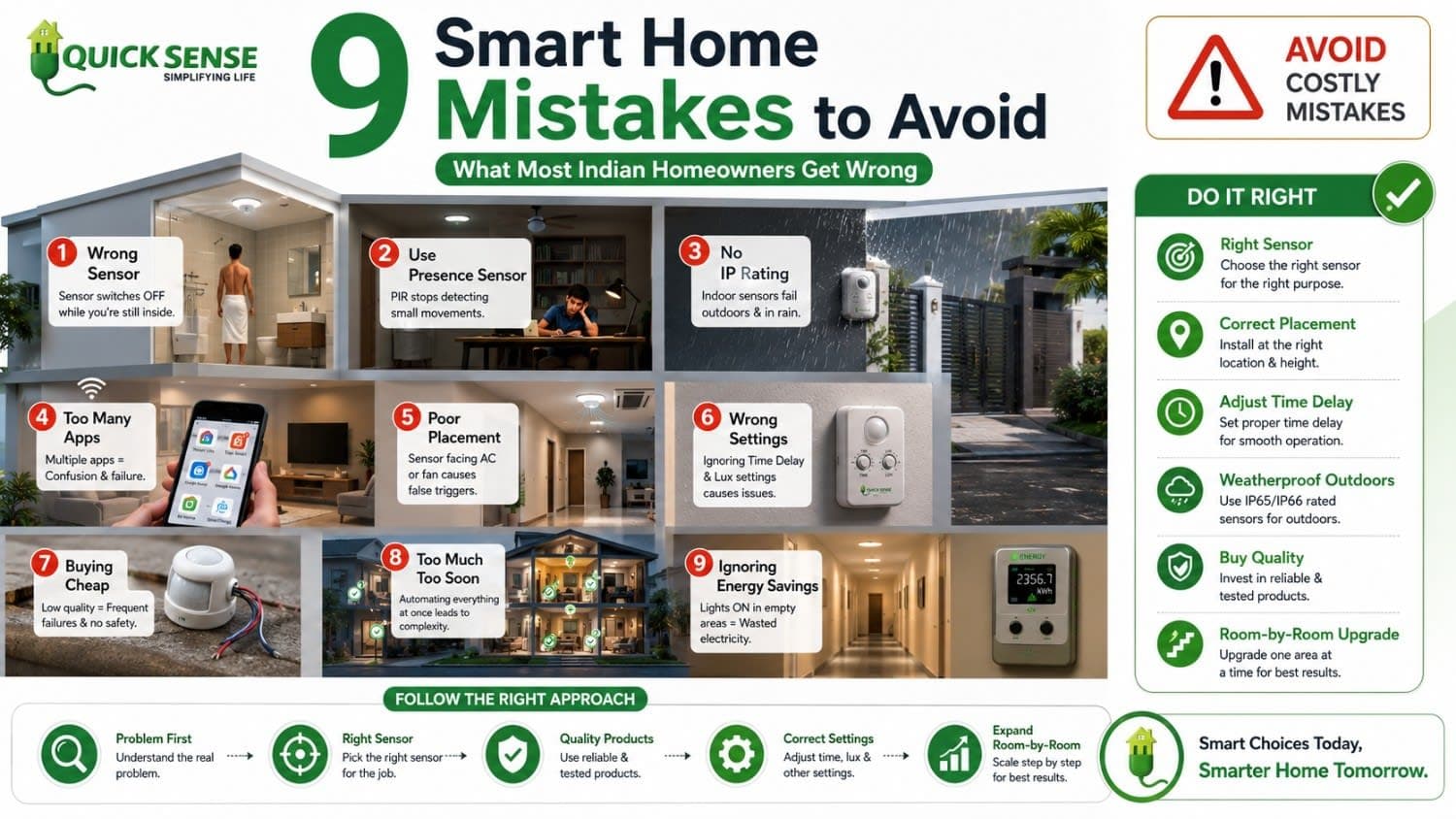
1. Buying gadgets instead of solving a problem
This is the big one. People buy a device because it looks cool, then try to find a use for it. Flip it around: start with the annoyance you actually want gone — "the bathroom light is always left on," "I want the stairs lit at night" — and pick the simplest thing that fixes it. Outcome first, device second. Everything else on this list gets easier once you do this.
2. Choosing the wrong type of sensor
A basic motion sensor at a desk or in a study is a classic mistake — you sit still, it decides the room's empty, and the light dies on you. Different sensors do different jobs. Where people move through, a PIR is perfect; where people sit still, you need a presence sensor; for large or partitioned areas, microwave works better. If you're unsure, our PIR vs microwave vs radar guide sorts it out in a couple of minutes.
3. Going cheap on the device itself
The ₹150 no-name sensor and the reliable branded one look identical in a photo. They don't behave identically on your wall. Cheap units are where false triggers, short range, and dead-in-six-months stories come from. You don't need the most expensive option — you need one with a genuine warranty and the right specs, as we cover in the motion sensor switch buying guide. Buy once, not twice.
4. Ignoring the settings (time delay and lux)
Most sensor problems aren't faults — they're settings nobody adjusted. The time delay decides how long the light stays on after movement; set it too short and it flickers off, too long and it wastes power. The lux (daylight) setting stops the light triggering in broad daylight. Two small dials, and they're the difference between "this is brilliant" and "this is annoying." Spend five minutes tuning them.
5. Forgetting the whole point — saving energy
A smart home that doesn't lower your bill is a missed opportunity. Automation's biggest everyday payoff is that lights and appliances run only when needed. If you're adding sensors anyway, put them where the waste is — corridors, bathrooms, store rooms — and pair them with energy monitoring so you can see the difference. We put numbers to it in how motion sensors cut energy bills.
6. Over-complicating everything
More apps, more hubs, more voice commands — and suddenly nobody in the house can operate the lights except you. The best automation needs no interaction: the light comes on because someone walked in, full stop. Resist the urge to build a control-room. Simpler setups are more reliable, easier for the whole family, and far less likely to end up switched off.
7. Bad placement and mounting
A great sensor in the wrong spot behaves like a bad one. Mount it too low, point it at an AC vent or a sunny window, or hide it behind a door, and you'll get missed detections or phantom triggers. Aim it across the area people move through, at the height the manual suggests, away from heat and airflow. Placement is free — and it fixes more problems than people expect.
8. Skipping weatherproofing outdoors
Indoor-rated devices die fast outside. India's heat, dust, and monsoon are brutal on anything at the gate, balcony, or parking. If a device is going outdoors, check for a proper outdoor/IP rating before you buy — it's the single spec people skip and regret. This applies to outdoor lights, cameras, and sensors alike.
9. Trying to do the whole house at once
Enthusiasm is great, but automating everything in one go is expensive, overwhelming, and a fast way to make mistakes 1–8 at scale. Do one or two rooms first, live with them, learn what you actually use — then expand. It's cheaper, calmer, and you end up with a home that fits how you really live. Our getting started guide and cost guide are built exactly for this room-by-room approach.
The short version
Start with the problem, not the product. Match the sensor to the room, buy quality, tune the settings, and grow one room at a time. Do that and a smart home stops being a gamble and becomes one of the most satisfying upgrades you'll make.
Not sure which upgrade makes sense first for your home? Tell us about your space and we'll suggest a sensible, mistake-free starting point — or browse our product range.