How to Automate Your Water Motor in India: Timer Switches & Level Controllers (2026 Guide)
Key takeaways
- Manual water-motor control quietly wastes water, electricity, and pump life — automation fixes all three.
- A timer switch runs the motor for a set time; a water level controller starts and stops it based on the actual tank level — the true "set and forget".
- Dry-run protection is the feature that saves your pump — it cuts the motor when there's no water to pump.
- Motor circuits carry high current, so always get an electrician to install anything on the pump wiring.
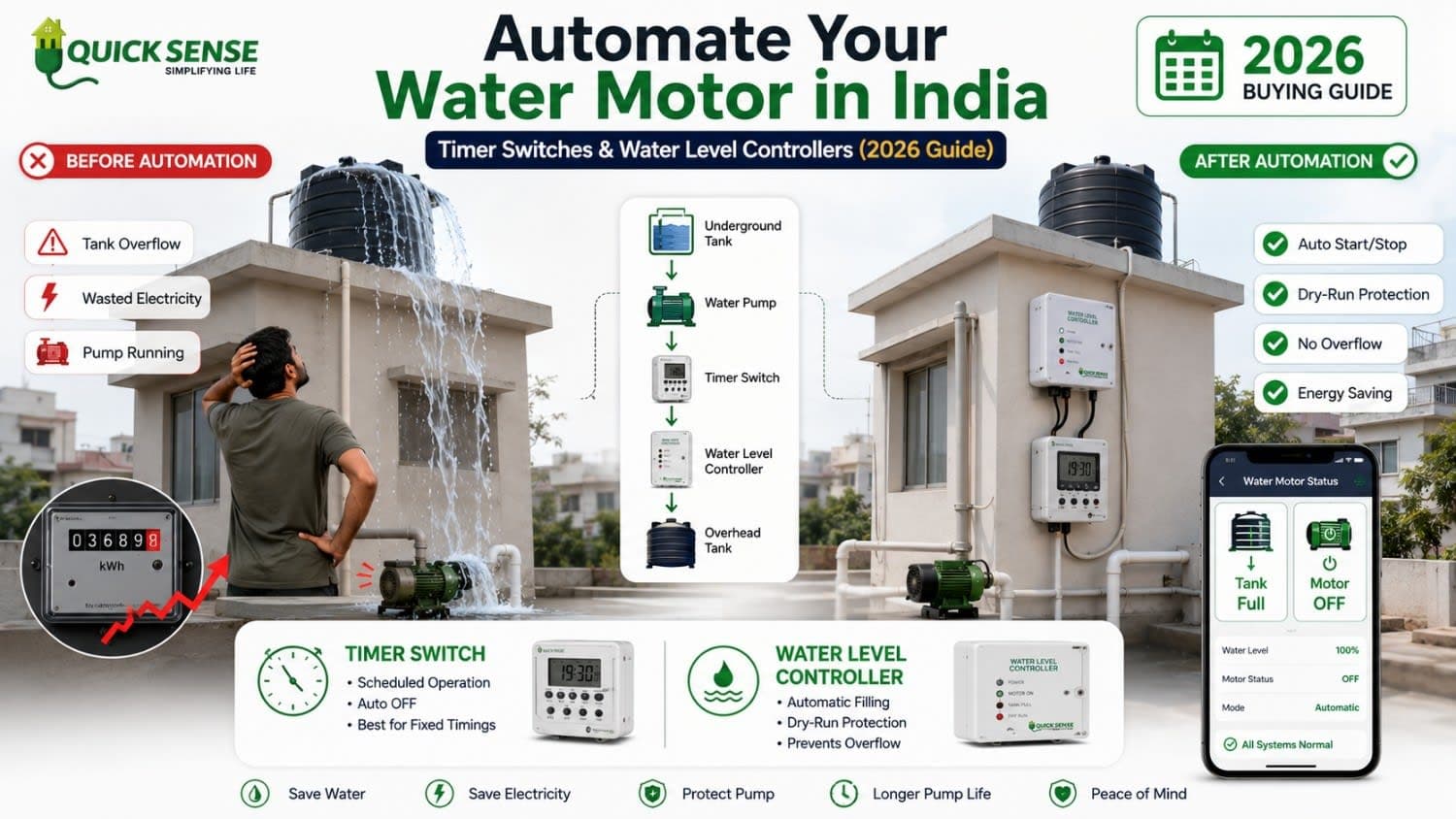
Picture the scene: you switch on the water motor, get busy with something, and twenty minutes later a neighbour points up at your overhead tank — water streaming down the wall, the pump still running. Wasted water, a wet building, and a motor that ran far longer than it needed to. Or the other version: the underground tank was empty, the motor ran dry for an hour, and now it's making an expensive grinding noise.
Almost every Indian home has lived one of these. The good news is that controlling your water pump by hand — and remembering to — is a solved problem. Here's how to automate it properly.
Why manual motor control is a daily headache
It's not just the drama of an overflow. Manual control costs you in quiet ways every single day:
- Wasted water every time the tank overflows before someone runs to switch off.
- Wasted electricity from the motor running longer than the tank actually needs.
- Shortened pump life when the motor runs dry because the sump was empty.
- The daily hassle of climbing up to check the tank, or timing it in your head.
Two devices fix all of this. Which one you need depends on how predictable your water supply is.
Option 1: The timer switch
A timer switch runs the motor for a set duration, or at set times of day, then shuts it off automatically. If you already know your tank fills in, say, 25 minutes, you set the timer once and stop babysitting the pump. Digital programmable timers let you schedule multiple on/off cycles — handy if your municipal supply comes at fixed hours.
Best for: homes where the fill time is consistent and you mainly want to stop the motor being left on. The catch: a pure timer doesn't know the actual water level — if the tank was already half full, it can still overflow. That's where the next device comes in.
Option 2: The automatic water level controller (the real "set and forget")
This is the proper fix. A water level controller uses sensors (or float switches) in your tanks to track the actual level. When the overhead tank drops below a set point, it starts the motor; when the tank is full, it switches off — by itself, every time. No overflow, no forgetting, no climbing up to check.
Because it responds to the real level, it adapts to whatever's happening — a half-full tank, a slow supply day — without you touching anything. For most homes, this is the upgrade that finally makes the water system just work in the background.
The feature that saves your pump: dry-run protection
Running a pump with no water to move is what kills motors. A controller with dry-run protection senses when the underground tank or sump is empty and cuts the motor before it damages itself. If you've ever burned out a pump, you know this one feature can pay for the whole device. When you're comparing controllers, treat dry-run protection as essential, not optional.
Timer switch or level controller — which should you choose?
- Choose a timer switch if your fill time is reliably the same and you simply want the motor to stop on its own.
- Choose a water level controller if you want true hands-off operation — no overflow, no dry run, no guesswork. For most families, this is the better long-term buy.
- Use both together for the most control: level-based automation with scheduled windows and dry-run safety.
What to check before you buy
- Motor phase & load rating: match single-phase or three-phase to your pump, with enough current headroom.
- Dry-run protection: as above — don't skip it.
- Manual override: you should always be able to run the motor by hand when needed.
- Weather & build quality: if any part sits outdoors near the tank, it must handle heat, dust, and monsoon.
- Clear indicators: simple lights or a display so anyone in the house understands the status.
Installation & safety — please read this
Water motors draw high current, and the wiring isn't the place to experiment. Unlike a plug-in gadget, anything connected to your pump circuit should be installed by a qualified electrician. It's a quick job for a professional and it keeps everyone safe. This is one automation you set up once, correctly, and then forget.
What you actually get back
Automating the pump pays you back three ways: the water you stop wasting in overflows, the electricity you stop spending on an over-run motor, and the pump you protect from dry runs. Add in never having to think about the tank again, and it's one of the most practical automations an Indian home can make — right alongside sensor-based lighting savings. If you're just beginning to automate the house, our getting started guide shows where this fits, and the cost guide helps you budget.
Want help choosing the right timer or level controller for your motor? Tell us your pump and tank setup and we'll point you to the right fit, or browse our product range.